






.png)

Nonlinear Flame-Retardant Synergism of Antimony Trioxide in Flexible PVC
POLYMER FLAME RETARDANCY · MECHANISTIC PERSPECTIVE
Why does the second phr markedly raise LOI, while later additions show diminishing returns?
| CORE DATA | INFLECTION POINT | MECHANISTIC DIAGNOSIS |
| LOI 27.5% → 30.0% | Plateau beyond 2 phr ATO | ATO-limited → HCl/transport-limited |
Abstract
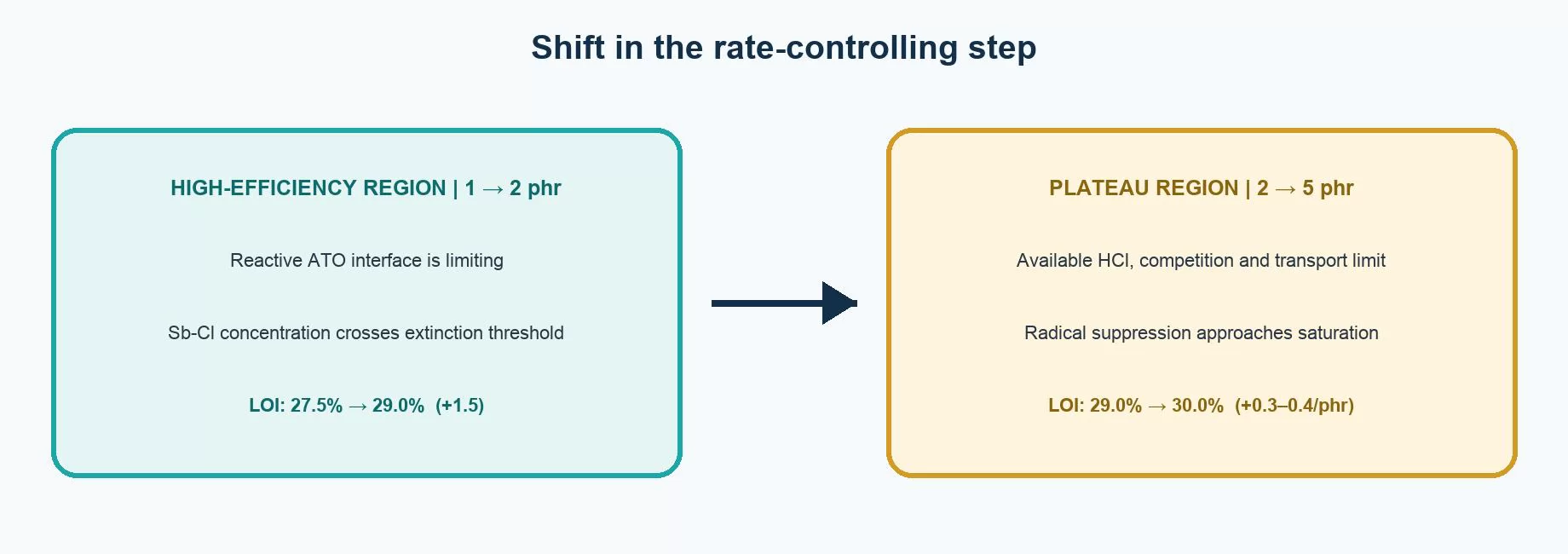
Antimony trioxide (ATO, Sb₂O₃) is a classical flame-retardant synergist for halogen-containing polymers. In the present flexible-PVC formulation plasticized with 45 phr DOP, increasing ATO from 1 to 2 phr raises the limiting oxygen index (LOI) from 27.5% to 29.0%. Further additions to 3, 4 and 5 phr increase LOI only to 29.3%, 29.6% and 30.0%, respectively, corresponding to marginal gains of merely 0.3--0.4 percentage points per phr. This nonlinearity reflects a shift in the rate-controlling step. At low loading, the available ATO reaction interface limits the formation of SbOCl and SbCl₃ from PVC-derived HCl. Once an effective concentration of gas-phase Sb--Cl species is established, radical inhibition approaches saturation and the overall response becomes constrained by available HCl, competing acid-scavenging reactions, particle dispersion and interphase mass transport.
1 Experimental Design and Marginal Efficiency
The formulation contains 100 phr PVC SG3, 45 phr DOP and 5 phr calcium-zinc stabilizer. ATO is increased from 1 to 5 phr while calcium carbonate is reduced by the same amount, maintaining a constant formulation total of 230 parts. Because no zero-ATO control was included, the present dataset quantifies the gain of the second phr relative to the first; it does not establish the absolute contribution of the first phr versus an ATO-free formulation.
| Property | Formulation 1 | Formulation 2 | Formulation 3 | Formulation 4 | Formulation 5 |
| ATO / phr | 1 | 2 | 3 | 4 | 5 |
| CaCO₃ / phr | 79 | 78 | 77 | 76 | 75 |
| LOI / % | 27.5 | 29.0 | 29.3 | 29.6 | 30.0 |
| Marginal LOI gain | --- | +1.5 | +0.3 | +0.3 | +0.4 |
| Tensile strength / MPa | 16.888 | 15.401 | 16.196 | 16.237 | 16.162 |
| Elongation at break / % | 301.231 | 317.127 | 299.907 | 325.364 | 312.772 |
| MSD | 70.39 | 67.84 | 73.57 | 64.35 | 64.51 |
| SDR | 50.24 | 42.29 | 55.96 | 45.36 | 43.74 |
Figure 1. ATO loading, LOI and marginal flame-retardant efficiency
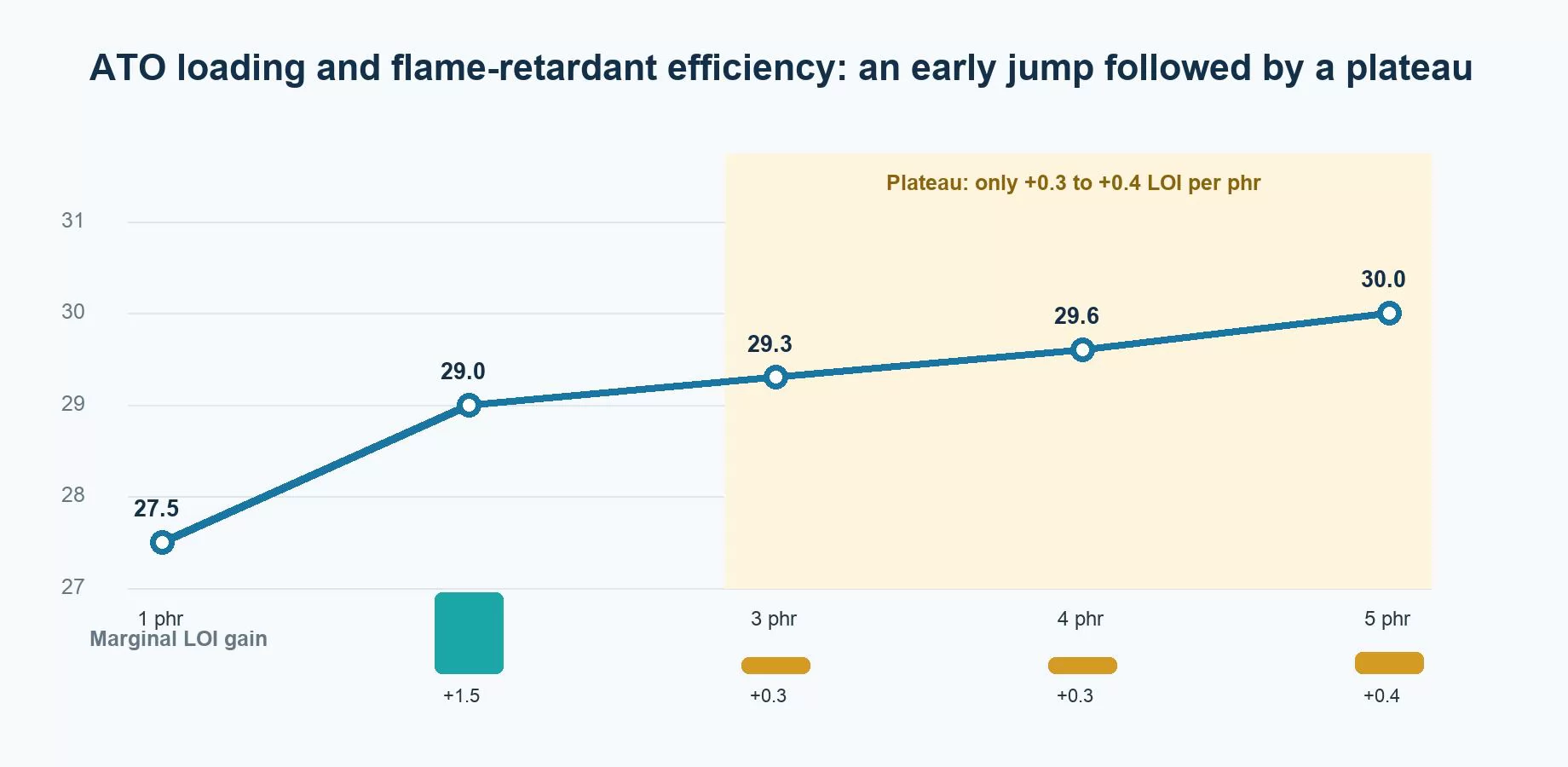

Figure 1 shows that the LOI gain associated with the second phr of ATO is approximately 3.75--5 times the gain obtained from each subsequent phr, indicating a rapid transition from a high-efficiency region to a marginal-efficiency plateau.
2 Gas-Phase Synergistic Mechanism in Flexible PVC/ATO
Flexible PVC initially undergoes zipper-like dehydrochlorination, generating HCl and conjugated polyenes, as shown in Eq. (1). The polyenes subsequently cyclize, crosslink, aromatize and crack. DOP, the principal plasticizer in this formulation, weakens interchain interactions and facilitates heat and mass transport, while also increasing the supply of combustible volatile products; consequently, flexible PVC is intrinsically more flammable than unplasticized PVC.


ATO is activated only after reaction with HCl. Progressive chlorination through intermediates such as SbOCl yields volatile SbCl₃; the overall transformation is approximated by Eq. (2).
_1788418792_WNo_1500d190.webp)

Figure 2. Gas-phase Sb--Cl flame-retardant pathway
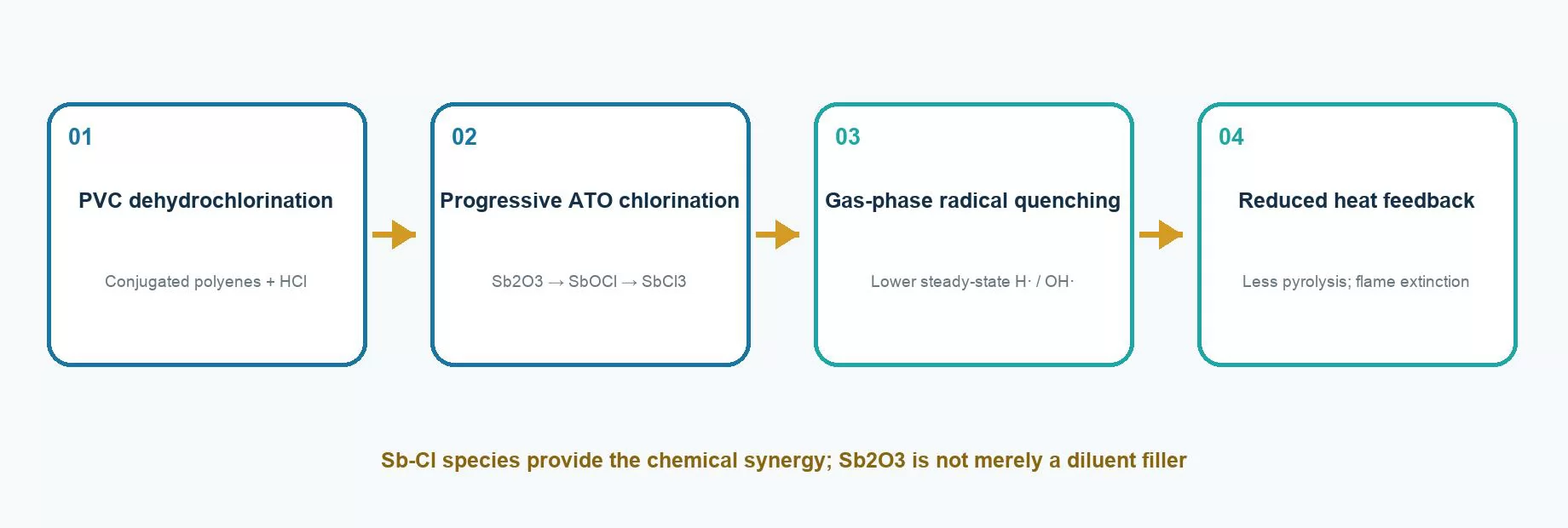

SbCl₃ and related antimony chlorides migrate into the flame zone and promote conversion of highly reactive H· and OH· radicals into less reactive chlorine-containing radicals or stable molecules. The resulting decrease in radical steady-state concentration lowers flame heat release and the heat flux returned to the condensed phase. Continued decomposition of PVC and DOP is thereby suppressed, establishing a reinforcing sequence: fewer radicals → weaker heat feedback → lower volatile generation → further flame attenuation.
3 Why Does the Second phr of ATO Give the Highest Marginal Efficiency?
At 1 phr ATO, PVC can release substantial HCl, but the Sb₂O₃ surface available for chlorination is limited. ATO population and effective surface area therefore constrain SbCl₃ formation. Raising ATO to 2 phr substantially increases the reactive interface, allowing more HCl to follow the Sb₂O₃ → SbOCl → SbCl₃ pathway and rapidly increasing the concentration of Sb--Cl species in the flame zone.
LOI is fundamentally a critical-extinction metric. Near the boundary between self-sustained burning and extinction, a modest decrease in radical concentration can reduce flame heat release below the minimum feedback required to maintain condensed-phase pyrolysis. The chemical change introduced by the second phr need not be proportionally large to move the system across this threshold, producing the observed 1.5-point LOI jump.
4 Why Does Efficiency Plateau Beyond 2 phr?
First, once Sb--Cl species reach an effective flame-zone concentration, the steady-state populations of H· and OH· have already been substantially depressed. The number of reactive radicals available to additional inhibitor no longer scales with nominal ATO loading; gas-phase suppression therefore displays saturation-like kinetics.
Second, ATO must react with HCl before becoming an effective gas-phase inhibitor. Beyond 2 phr, the controlling step can shift from ATO availability to PVC dehydrochlorination rate, HCl diffusion, further chlorination of SbOCl and transport of SbCl₃ into the flame. Additional nominal ATO therefore does not imply a proportional increase in effective SbCl₃.
Third, the formulation contains 75--79 phr CaCO₃ and 5 phr calcium-zinc stabilizer, both of which may compete for HCl. The CaCO₃ reaction is shown in Eq. (3). Once HCl is immobilized as a nonvolatile chloride, it is no longer available for SbCl₃ formation. The theoretical chlorine content of PVC is therefore not equivalent to the locally available HCl concentration at the burning interface.
_1788419197_WNo_1500d190.webp)

Finally, increasing ATO raises the probability of particle agglomeration. Particles inside agglomerates cannot efficiently contact HCl, decreasing the effective reaction area per unit mass. Moreover, ATO acts predominantly through the gas phase and has limited ability to build a strong, compact condensed-phase barrier. Once the gas-phase pathway approaches saturation, no second pathway continues to strengthen in proportion to ATO loading.
Figure 3. Shift in the rate-controlling step of ATO flame retardancy

5 Why Does Smoke Density Not Decrease Monotonically with ATO?
MSD decreases overall from 70.39 to 64.51, yet rises to 73.57 at 3 phr ATO; SDR also fluctuates. Flame retardancy and smoke suppression are not identical processes. Lower flame heat feedback can reduce total polymer pyrolysis and smoke evolution, whereas inhibition of gas-phase oxidation can prevent aromatic fragments and soot precursors from being fully converted to CO₂ and H₂O, increasing products of incomplete combustion. A higher LOI therefore does not guarantee a proportional decrease in smoke density. ATO should be regarded primarily as a gas-phase synergist rather than a stand-alone smoke suppressant.
6 Engineering Conclusions and Recommended Validation
The current data support two loading regimes. Increasing ATO from 1 to 2 phr defines a high-marginal-efficiency region and raises LOI from 27.5% to 29.0%. Beyond 2 phr, LOI continues to increase, but each additional phr contributes only 0.3--0.4 percentage points, indicating a plateau jointly controlled by HCl availability, competing reactions, particle dispersion and mass transport. If an LOI near 29% is required, 2 phr ATO provides comparatively high input efficiency. Approaching 30% requires approximately 5 phr, with corresponding cost, smoke and regulatory trade-offs.
Recommended work includes a zero-ATO control, independently compounded replicates and 0.5-phr increments between 1 and 3 phr. TG-FTIR or TG-MS should track HCl and volatile antimony species; SEM-EDS/XPS should assess ATO dispersion and Sb/Cl distributions in the residue; cone calorimetry should quantify heat release, total smoke and CO/CO₂ yields. Holding ATO constant while varying CaCO₃ and calcium-zinc stabilizer would directly test the proposed competition for HCl.
References
1. Yoshinaga, S. et al. Reaction of poly(vinyl chloride) with antimony(III) oxide. Nippon Kagaku Kaishi, 1973, 175--182. DOI: 10.1246/nikkashi.1973.175.
2. Stec, A. A. et al. PVC-Based Copper Electric Wires under Various Fire Conditions: Toxicity of Fire Effluents. Materials, 2020, 13, 1111.
3. A New Perspective on Hydrogen Chloride Scavenging at High Temperatures for Reducing the Smoke Acidity of PVC Cables in Fires. Fire, 2022, 5, 127.
Your Name*
Your Email*
-
2026-Sep-03Nonlinear Flame-Retardant Synergism of Antimony Trioxide in Flexible PVCLearn how antimony trioxide improves flame retardancy in flexible PVC, with LOI data, ATO loading effects, synergistic mechanisms, and efficiency limits beyond 2 phr.
-
2026-Aug-06Improving LOI (Limiting Oxygen Index) with Magnesium HydroxideMagnesium Hydroxide as an effective low smoke flame retardant solution, offering excellent heat absorption, smoke suppression, and halogen-free performance for cable compounds, polymer materials, and industrial applications requiring enhanced fire safety and environmental compliance.
-
2026-Jul-20Magnesium Hydroxide for EPDM Rubber: Benefits, Dosage, and TipsThis comprehensive guide explains how Magnesium Hydroxide acts as an eco-friendly, high-thermal-stability flame retardant for EPDM rubber in automotive and cable applications, detailing optimal dosage, processing tips, and the premium surface-modified solutions offered by KMT.



-

 +86-931-7653361
 Room 1212, 1213, Jinhe Building, No. 1264 Beibinhe West Road, Anning District, Lanzhou City, Gansu Province, China.


-
Quick Links
-
Products


