






.png)

Magnesium Hydroxide: REACH, ROHS and UL Compliance Explained
As global emphasis on environmental protection, occupational health, and personal safety grows, the application of Halogen-Free Flame Retardant (HFFR) and Low Smoke Zero Halogen (LSZH) materials in wire and cable, electronics, automotive parts, and building materials is experiencing explosive growth. As a highly efficient inorganic flame retardant, Magnesium Hydroxide (MDH) is rapidly replacing traditional halogenated flame retardants due to its triple functionality: flame retardancy, smoke suppression, and matrix filling.
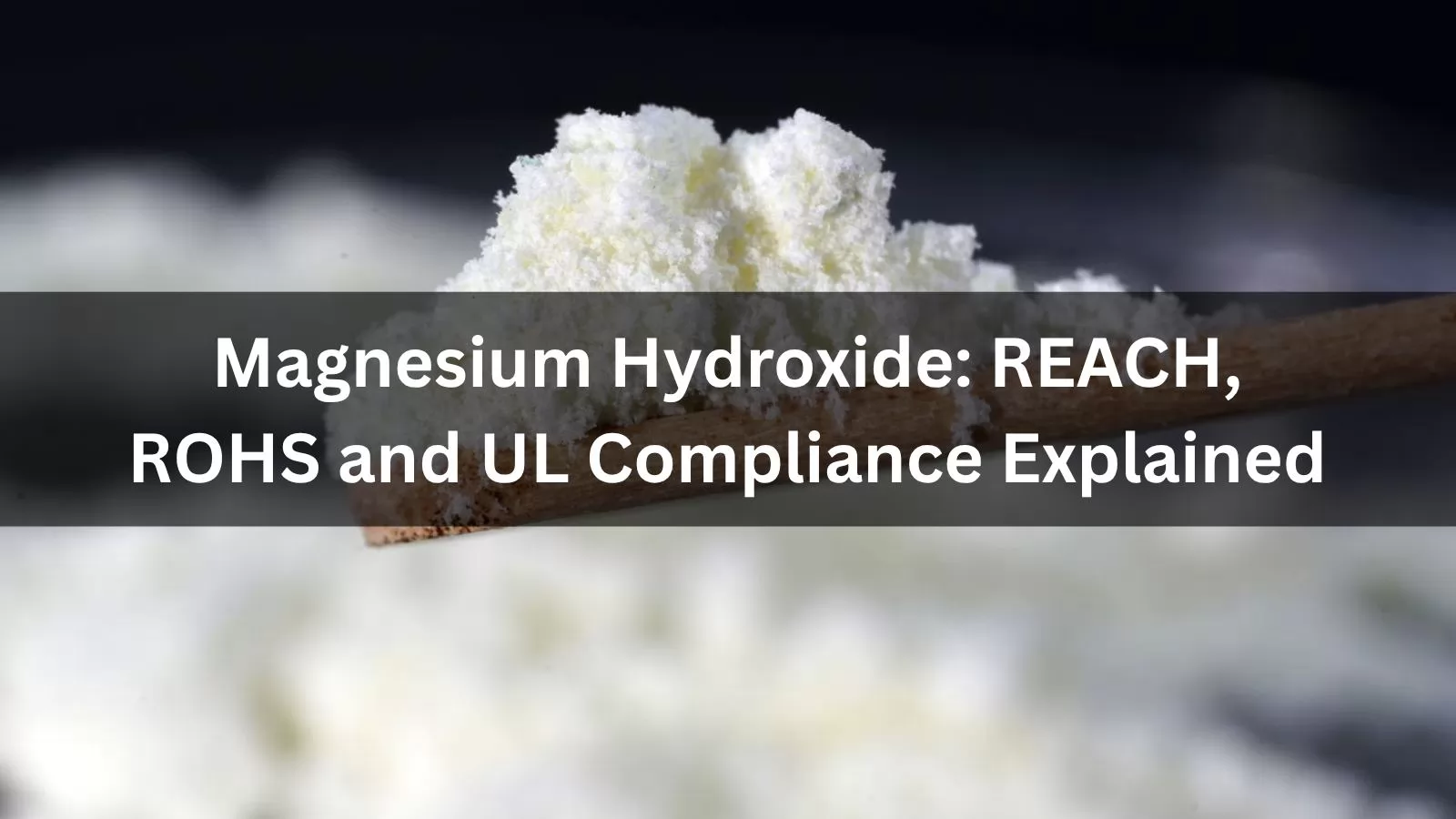
Technically known as an inorganic compound widely utilized for cable and wire insulation, MDH decomposes endothermically when exposed to heat—absorbing energy and releasing heavy water vapor. This advanced thermodynamic process effectively cools the polymer matrix, suppresses active flames, minimizes smoke density, and delays fire propagation. Unlike halogenated options, it generates no toxic or corrosive gasses, positioning it as the premier choice for modern HFFR compounding lines.
In the globalized trade system, material compliance is the primary threshold for entering international markets. As a professional manufacturer focused on flame retardant research and production since 2008, KMT Industrial (HK) Ltd operates with a mature R&D team and holds ISO 9001:2015, ISO 14001, and ISO 45001 certifications. With products exported to over 30 countries and regions, this comprehensive guide leverages technical data to deeply analyze the selection criteria, application matrices, and compliance performance of MDH under international standards.
Table of Contents
1. Introduction to MDH in Cable Industry
4. How MDH Works as Flame Retardant
5. MDH Applications in Cable & Wire
6. Why Choose KMT Industrial's MDH
7. How to Choose MDH for Cable Manufacturing
8. Global Trends in Cable Flame Retardants
9. MDH Advantages vs Other Flame Retardants
10. Conclusion & Recommendations
1. Introduction to Flame Retardant Magnesium Hydroxide in the Cable and Wire Industry
In the cable and wire industry, flame retardants are essential for ensuring the safety and durability of electrical and communication cables. Flame retardant magnesium hydroxide (MDH) has become one of the most preferred halogen-free additives for HFFR cable compounds, power cables, and communication wires. As global demand for safer, non-toxic, and environmentally friendly materials rises—driven by RoHS, REACH, and fire safety standards like UL94 V-0—manufacturers increasingly turn to magnesium hydroxide for its exceptional flame resistance and smoke suppression.
Magnesium hydroxide flame retardant is used extensively in the production of cables, wires, and other electrical components, serving as an effective and sustainable solution to reduce fire hazards, minimize smoke density, and meet stringent safety regulations. This guide explores the types, grades, and applications of magnesium hydroxide in the cable industry, with a focus on KMT Industrial—a leading China magnesium hydroxide manufacturer with over 15 years of experience, ISO9001/ISO14001/ISO45001 certification, and EU REACH registration.
Key Industry Highlights:
- Global halogen-free flame retardant market expected to reach $2.8 billion by 2028
- Magnesium hydroxide market growing at CAGR 7.2% (2023-2030)
- Over 60% of cable manufacturers now prefer halogen-free solutions
- MDH can reduce smoke density by up to 80% compared to halogenated alternatives
2. What is Magnesium Hydroxide (MDH) and Why is it Used?
As a premium green inorganic filler, Magnesium Hydroxide is engineered to deliver exceptional flame inhibition and physical stabilization within polymer matrixes. By replacing toxic halogen components, it prevents corrosive gas accumulation while successfully upgrading the compound's overall fire safety classification.
KMT Industrial specializes in multiple grades of magnesium hydroxide for cable manufacturing, including hexagonal magnesium hydroxide (HP7, HP7N), ultrafine nano magnesium hydroxide (P1, P1S, P1SA), and precipitated magnesium hydroxide (PM5S, PM5SN, PM3SN). These products deliver high purity (≥95–99% Mg(OH)₂), low iron content (≤0.002–0.05% Fe₂O₃), and excellent dispersion—meeting RoHS and REACH requirements for global cable and wire applications.
2.1 Key Chemical and Physical Properties of MDH
Understanding the fundamental properties of magnesium hydroxide helps engineers and formulators make informed decisions for cable compound design:
| Property | Value / Range | Significance for Cable Applications |
|---|---|---|
| Chemical Formula | Mg(OH)₂ | Inorganic, stable compound |
| Molecular Weight | 58.32 g/mol | Lightweight additive for polymers |
| Decomposition Temperature | 332-340°C | Higher than ATH (~200°C), enables PP/PE processing |
| Endothermic Heat | ~1300 J/g | Strong heat absorption for flame suppression |
| Water Release | ~31% by weight | Dilutes combustible gases, smoke suppression |
| Mohs Hardness | 2.5-3.0 | Low abrasion on processing equipment |
| pH (suspension) | 9.5-10.5 | Mildly alkaline, safe handling |
3. Types and Grades of Magnesium Hydroxide Used in Flame Retardancy
Flame retardant magnesium hydroxide for cable and wire is categorized by production method, particle size, surface coating, and crystal structure. These factors directly affect UL94 V-0 performance, extrusion throughput, mechanical properties, and cost efficiency in HFFR cable compounds.
3.1 By Production Method
- Synthetic Magnesium Hydroxide: Produced via chemical precipitation (e.g., MgCl₂ + 2NH₃·H₂O → Mg(OH)₂↓ + 2NH₄Cl), yielding high purity (≥99%), high whiteness, and excellent flame retardancy. KMT Industrial's hexagonal magnesium hydroxide HP series and precipitated magnesium hydroxide PM series are synthesized for EVA, PE, XLPE, and PVC cable compounds.
- Hydrothermal Method Magnesium Hydroxide: High-temperature water treatment produces controlled crystal morphology (e.g., hexagonal plate structure) for superior fluidity and dispersion in HFFR formulations.
- Ore-Method Magnesium Hydroxide (Brucite Powder): Mined from natural brucite ore, crushed and ground. Cost-effective for some cable applications; KMT offers B-series brucite for PVC and HFFR cable compounds.
3.2 By Surface Coating Modification
Surface modification improves dispersibility, polymer compatibility, lower compounding torque, and higher MFI—critical for cable extrusion and UL94 V-0 performance.
- Uncoated Grade (P1, PM5, HP7): Raw powder for general flame retardant applications and cost-sensitive formulations.
- Stearic Acid Coating (P1SA): Improves flowability and compatibility; ideal for HFFR PE pipes and truck tarp compounds with faster extrusion rates.
- Silane Coating (P1S, PM5S): Enhances polymer bonding and dispersion; suitable for LSZH cable compounds and engineering plastics.
- KMT Patent Coating (HP7N, PM5SN, PM3SN): Proprietary formula for easy dispersing in PP, PE, EVA, POE, EPDM, XLPE, PA, ABS—reducing torque by up to 18% while maintaining UL94 V-0.
3.3 By Particle Size
- Ultrafine (D50 0.8–1.2 μm): P1 series—high LOI, excellent self-extinguish, ideal for HFFR cable and engineering plastics.
- Superfine (D50 1.2–1.6 μm): HP7/HP7N—hexagonal plate, good char formation, high elongation at break for EVA/XLPE.
- Fine (D50 1.4–1.7 μm): PM5/PM5S/PM5SN—cost-saving precipitated MDH for HFFR and LSZH compounds.
- Medium (D50 2.5–3.2 μm): PM3/PM3SN—alternative for normal HFFR compound with lower cost.
- Coarse (D50 35–45 μm): PM10—specialty applications and magnesium derivatives.
KMT's wire and cable application guide recommends specific grades (HP7, HP7N, PM5SN, PM3SN, HM2V, B3.5SA, A1) by polymer type and cable specification.
3.4 KMT Industrial MDH Product Grades Comparison Table
| Grade | D50 (μm) | Surface Treatment | Purity | Recommended Application |
|---|---|---|---|---|
| HP7 | 1.2-1.6 | None | ≥97% | EVA/XLPE HFFR cables |
| HP7N | 1.2-1.6 | KMT Patent | ≥97% | Premium HFFR, low torque |
| P1 | 0.8-1.2 | None | ≥95% | Cost-effective HFFR |
| P1S | 0.8-1.2 | Silane | ≥95% | LSZH cables, engineering plastics |
| PM5SN | 1.4-1.7 | KMT Patent | ≥99% | Power cables, HFFR jackets |
| PM3SN | 2.5-3.2 | KMT Patent | ≥98% | Cost-optimized HFFR |
4. How Does Magnesium Hydroxide Act as a Flame Retardant?
Magnesium hydroxide acts as a flame retardant through three key mechanisms: (1) Endothermic decomposition—absorbing heat and releasing water vapor (Mg(OH)₂ → MgO + H₂O) to cool the material and dilute combustible gases; (2) Char formation—divalent Mg²⁺ promotes polymer aromatization and graphitic char yield, forming a protective barrier that blocks oxygen and heat; (3) Smoke suppression—MgO with high surface area absorbs smoke particulates and reduces visible smoke density, critical for LSZH cables and enclosed spaces.
In cable manufacturing, magnesium hydroxide is incorporated into EVA, PE, XLPE, PVC, and TPU compounds to provide halogen-free fire resistance without toxic or corrosive gas emissions. KMT Industrial's magnesium hydroxide products—HP7, HP7N, P1 series, and PM5S—offer processing temperatures below 300°C, high LOI, and excellent smoke absorption, helping cable manufacturers achieve UL94 V-0 and IEC 60332 compliance globally.
4.1 Detailed Flame Retardant Mechanisms
1. Endothermic Decomposition Process:
When heated above 332°C, MDH undergoes endothermic decomposition. This reaction absorbs approximately 1300 J/g of heat energy, effectively cooling the polymer matrix and slowing the combustion process. The released water vapor dilutes combustible gases and oxygen concentration in the flame zone.
2. Protective Char Layer Formation:
The divalent Mg²⁺ ions promote polymer aromatization and graphitic char formation. This char layer acts as:
- Physical barrier – blocks heat and oxygen transfer
- Mass transfer inhibitor – prevents volatile fuel release
- Insulation layer – reduces heat feedback to the polymer
3. Smoke Suppression Benefits:
The residual MgO particles (formed after decomposition) have high surface area and actively adsorb smoke particles. This results in:
- Up to 80% reduction in visible smoke density
- Improved evacuation safety in enclosed spaces
- Compliance with IEC 61034 smoke density standards
5. Applications of Flame Retardant Magnesium Hydroxide in the Cable and Wire Industry
Flame retardant magnesium hydroxide (MDH) is widely used in cable and wire manufacturing across multiple segments. KMT products—Magnesium Hydroxide, Hydromagnesite, and Aluminum Hydroxide—serve as effective flame retardants and smoke suppressants in EVA, PE, POE, EPDM, XLPE, PVC, and TPU-based cable compounds. Recommended grades by application:
- Power Cables & HFFR Cable Compounds: HP7, HP7N, PM5SN, PM3SN for EVA/PE/POE low-smoke halogen-free jackets; UL94 V-0 and IEC 60332 compliance.
- Communication & Data Cables: LSZH (low smoke zero halogen) compounds with PM5S, PM5SN, or HP7N for commercial and residential buildings.
- Automotive Cables: HP7N/ATH blends for 300°C-stable PP automotive wire; P1S silane-grade for thermal cycling and durability.
- Industrial Cables: PM5SN, PM3SN for FRLS PVC, FR PE cable compounds; engineering plastics (PA66, ABS, PBT) with PM5S for connectors and housings.
KMT Industrial's wire and cable solutions provide formula support, lab trials, and FR expert consultation to ensure consistent quality and reliable UL94 performance.
5.1 Real-World Application Cases
Case Study 1: High-Rise Building Power Cables
Challenge: A major cable manufacturer needed to meet stringent IEC 60332-1-2 flame test requirements while maintaining mechanical flexibility for installation in high-rise buildings.
Solution: KMT Industrial recommended HP7N (patent-coated hexagonal MDH) at 58% loading in EVA-based HFFR compound.
Results: UL94 V-0 achieved | Smoke density reduced by 72% | Tensile elongation maintained at 180% | 15% torque reduction vs. uncoated MDH
Case Study 2: Automotive Wire Harnesses
Challenge: An automotive supplier required flame-retardant PP wire insulation with 300°C thermal stability for under-hood applications.
Solution: PM5SN (patent-coated precipitated MDH) blended with ATH at optimized ratio for PP compound.
Results: ISO 6722 thermal aging compliance | LV 112 flame test passed | Cost reduction of 12% vs. all-ATH formulation
6. Why KMT Industrial's Magnesium Hydroxide is Ideal for Cable and Wire Manufacturing
KMT Industrial (HK) Ltd has been a leading magnesium hydroxide manufacturer in China since 2008, with one R&D center, two ISO9001/ISO14001/ISO45001-certified plants, and exports to 30+ countries. Their hexagonal, ultrafine nano, and precipitated magnesium hydroxide grades are specifically designed for cable and wire manufacturing.
- High Purity & Consistent Quality: HP7 & HP7N with ≤0.002% Fe₂O₃ eliminate discoloration in medical-grade tubing; PM5S offers 99.5% purity and 100% whiteness for LSZH compounds; all products comply with RoHS and EU REACH.
- Halogen-Free & Sustainable: KMT provides environmentally friendly flame retardants without brominated or chlorinated compounds—meeting global regulatory trends and reducing toxic gas emissions.
- Technical Support & Formula Service: Basic formula support for FR PVC and HFFR cable compounds, lab trials, compound testing, and FR expert consultation—helping customers achieve UL94 V-0 and optimize MDH loading for cost savings.
- Global Warehouse & Export: Efficient fulfillment and quick order delivery; Turkish warehouse supports African and European cable clients with 72-hour stocking during supply disruptions.
KMT Industrial Certifications & Capabilities:
| ISO 9001:2015 - Quality Management | ISO 14001:2015 - Environmental Management |
| ISO 45001:2018 - Occupational Health & Safety | EU REACH - Registered for European Market |
| RoHS Compliant - Heavy Metal Free | 30,000+ MT/year - Production Capacity |
7. How to Choose the Right Magnesium Hydroxide for Cable Manufacturing
Selecting the right magnesium hydroxide grade for cable manufacturing depends on polymer type, flame test requirements, cost targets, and processing conditions:
- Cable Type & Polymer: EVA/PE/POE/XLPE HFFR cable→HP7, HP7N, PM5SN, HM2SA; FRLS PVC→PM3V, HM2V, A1; PP/GF-reinforced→PM5SN, PM3SN; PA66/ABS/PBT connectors→PM5S.
- UL94 & LOI Requirements: For UL94 V-0, MDH loading typically ranges 50–65% depending on polymer; KMT's UL94 V-0 guide provides polymer-specific loading and synergistic additive recommendations.
- Processing & Cost: Patent-coated grades (HP7N, PM5SN) reduce torque and improve MFI; ultrafine P1 series offers cost savings for HFFR formulas; consider extrusion throughput and energy cost per kg.
7.1 Grade Selection Quick Reference Guide
| Cable Type | Polymer | Recommended Grade | Typical Loading (%) | Key Benefit |
|---|---|---|---|---|
| Power Cable | EVA/XLPE | HP7N | 55-62% | Low torque, high elongation |
| Data/Comm Cable | PE/POE | PM5SN | 58-65% | Cost-effective, LSZH |
| Automotive Wire | PP | P1S | 50-58% | 300°C thermal stability |
| Industrial Cable | PVC | PM3V | 45-55% | FRLS compliance |
| Connector Housing | PA66/ABS | PM5S | 40-50% | Silane coating for bonding |
8. Global Trends in Flame Retardant Materials for Cable and Wire Production
The global cable and wire flame retardant market is shifting toward halogen-free, sustainable solutions. Key trends include: (1) Phase-out of halogenated compounds—EU restrictions on brominated/chlorinated flame retardants drive adoption of magnesium hydroxide and aluminum hydroxide; (2) LSZH and HFFR demand growth—data centers, buildings, and transportation increasingly require low-smoke zero-halogen cables for safety and regulatory compliance; (3) Cost optimization—blends of MDH/ATH, precipitated MDH (PM5S, PM5SN), and ultrafine P1 series enable formula cost reduction while maintaining UL94 V-0; (4) Regional supply resilience—global warehouse networks (e.g., KMT's Turkish depot) support continuity during logistics disruptions. Magnesium hydroxide continues to gain share over ATO and halogenated options due to its non-toxic profile, smoke suppression, and alignment with circular economy and REACH/RoHS standards.
Global Market Projections & Regulatory Outlook:
- Market Growth: Halogen-free flame retardant market expected to grow from $2.1B (2023) to $3.8B (2030) at CAGR 8.2%, with MDH being the fastest growing segment.
- EU REACH & RoHS: Restrictions on brominated flame retardants (BFRs) and additional halogenated compounds are continually expanding.
- Building Codes: Mandatory LSZH implementation in public buildings across the EU, Middle East, and Asia.
- Standards Evolution: Updated smoke density requirements (IEC 61034) and automotive standards (LV 112, ISO 6722) demand higher fire safety profiles.
9. Advantages of Using Magnesium Hydroxide Over Other Flame Retardants
Compared to halogenated flame retardants (brominated/chlorinated), ATH, and ATO, magnesium hydroxide (MDH) offers distinct advantages for cable and wire applications:
- Halogen-Free & Non-Toxic: MDH does not release corrosive or toxic halogen acid gases when burned—unlike decaBDE or chlorinated paraffin—reducing health risks and meeting RoHS/REACH requirements for LSZH cables.
- Better Char-Forming & Smoke Suppression vs. ATH: Divalent Mg²⁺ promotes polymer aromatization and graphitic char yield, whereas trivalent Al³⁺ does not; MDH helps FR compounds pass UL burning tests more easily and reduces smoke density better than ATH.
- Higher Thermal Stability: MDH decomposes at ~340°C vs. ATH ~200°C—enabling processing up to 300°C for PE, PP, EVA, XLPE cable compounds without premature degradation.
- Cost Efficiency: Precipitated MDH (PM5S, PM5SN) and ultrafine P1 series offer competitive pricing; MDH/ATH synergies can reduce overall formula cost while achieving UL94 V-0.
9.1 Flame Retardant Comparison Table
| Property | MDH | ATH | Brominated FR | ATO |
|---|---|---|---|---|
| Decomposition Temp | 332-340°C | ~200°C | 200-300°C | N/A |
| Halogen-Free | Yes | Yes | No | Yes |
| Toxic Gas Release | None | None | High | Low |
| Smoke Suppression | Excellent | Good | Poor | Moderate |
| Processing Temp Range | Up to 300°C | Up to 200°C | Varies | Up to 300°C |
| RoHS/REACH Compliant | Yes | Yes | Restricted | Restricted |
10. Conclusion and Recommendations
Flame retardant magnesium hydroxide (MDH) is an essential halogen-free material for the cable and wire industry—delivering safe, effective fire resistance, smoke suppression, and compliance with global standards (UL94 V-0, IEC 60332, RoHS, REACH). Whether you need hexagonal magnesium hydroxide (HP7, HP7N) for high-performance HFFR cable, ultrafine nano MDH (P1, P1S, P1SA) for cost-saving formulations, or precipitated magnesium hydroxide (PM5S, PM5SN) for LSZH compounds, KMT Industrial offers certified, high-purity products with formula support and lab trials. Request a quote today to optimize your cable compound for performance and cost.
Ready to Optimize Your Cable Compound?
Connect with KMT Industrial's flame retardant experts for free formula consultation, lab trials, UL94 V-0 optimization guidance, and technical data sheets.
Contact KMT Industrial Now →11. Related Blogs
· How to Reduce Cable Compound Costs by Optimizing MDH Formulation
· What Is the Optimal MDH Loading to Reach UL94 V-0?
· Cable and Wire Industry's Use of Flame Retardant Magnesium Hydroxide
· 9 Things Need to Be Considered When Choosing Flame Retardant
12. Frequently Asked Questions (FAQs)
Need Technical Support?
KMT Industrial's flame retardant experts are ready to help you optimize your cable compound formulation.
Email: info@kmtindustrial.com | Website: www.kmtindustrial.com
Your Name*
Your Email*
-
2026-Sep-03Nonlinear Flame-Retardant Synergism of Antimony Trioxide in Flexible PVCLearn how antimony trioxide improves flame retardancy in flexible PVC, with LOI data, ATO loading effects, synergistic mechanisms, and efficiency limits beyond 2 phr.
-
2026-Aug-06Improving LOI (Limiting Oxygen Index) with Magnesium HydroxideMagnesium Hydroxide as an effective low smoke flame retardant solution, offering excellent heat absorption, smoke suppression, and halogen-free performance for cable compounds, polymer materials, and industrial applications requiring enhanced fire safety and environmental compliance.
-
2026-Jul-20Magnesium Hydroxide for EPDM Rubber: Benefits, Dosage, and TipsThis comprehensive guide explains how Magnesium Hydroxide acts as an eco-friendly, high-thermal-stability flame retardant for EPDM rubber in automotive and cable applications, detailing optimal dosage, processing tips, and the premium surface-modified solutions offered by KMT.


-

 +86-931-7653361
 Room 1212, 1213, Jinhe Building, No. 1264 Beibinhe West Road, Anning District, Lanzhou City, Gansu Province, China.


-
Quick Links
-
Products


